
- Blogs
- E-commerce Development
- BigCommerce VS Shopify: Which eCommerce Platform Is Fit for Your Business?
- Blogs
- E-commerce Development
- BigCommerce VS Shopify: Which eCommerce Platform Is Fit for Your Business?
BigCommerce VS Shopify: Which eCommerce Platform Is Fit for Your Business?
- Published: March 31, 2026

Written By : Sualeha
Choosing the right eCommerce platform can make or break your online store. In the BigCommerce vs Shopify comparison, both offer powerful solutions, but the best fit depends on your business type, catalog size, and growth goals.
At Solcoders, we’ve analyzed pricing, features, B2B tools, SEO, and AI capabilities to deliver an objective, transparent comparison.
This article provides a side-by-side overview of Shopify development and bigCommerce development, covering usability, built-in features, scalability, and growth potential. Making the right choice today will shape your store’s operations, expansion, and long-term success.
BigCommerce vs Shopify Comparison Guide for Online Stores
Understanding each platform’s core design philosophy explains every difference you will find when comparing Shopify vs BigCommerce features, pricing, and developer experience.
What Is Shopify? Quick Overview for Businesses
Launched in 2006, Shopify powers over 6 million active stores worldwide, making it the most widely adopted eCommerce platform.
However, its massive ecosystem, beginner-friendly setup, and polished themes make it the go-to choice for DTC brands, dropshippers, and first-time merchants who want a fast and easy online store setup.
BigCommerce Overview for Online Stores
BigCommerce launched in 2009 and serves over 130,000 B2B and B2C merchants across 150 countries.
It is an open SaaS platform, meaning it ships with more built-in features and less dependence on third-party apps. It is the go-to platform for stores with complex catalogs or B2B pricing needs.
Pricing and Total Cost of Ownership 2026
Plan pricing is only one part of what you pay. The total cost of running a store includes apps, themes, developer work, and transaction fees, and that number looks very different in any honest BigCommerce and Shopify pricing comparison.
Shopify Hidden App Cost
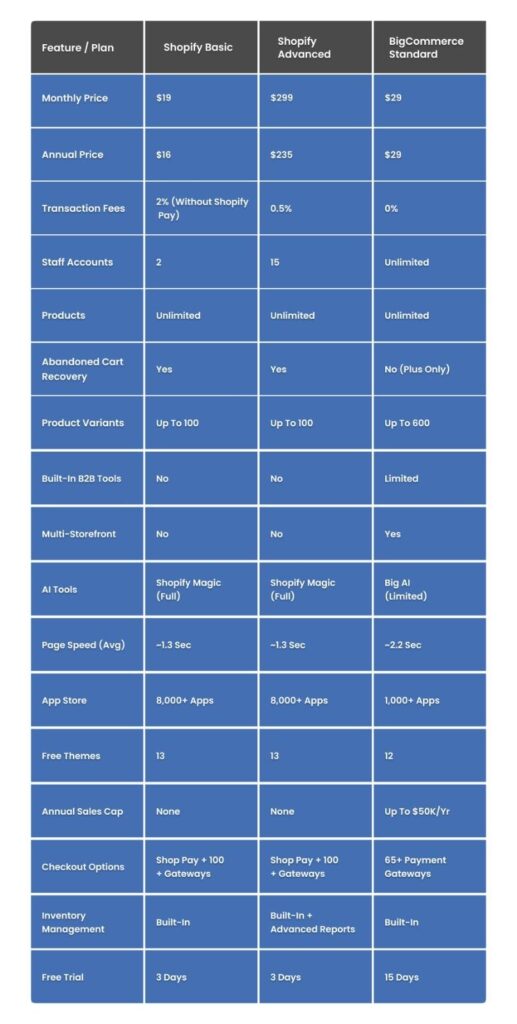
The average Shopify store invests $100–$300 per month on third-party apps to enable features BigCommerce provides out of the box, including advanced product filtering, B2B pricing, and abandoned cart recovery. Consider this additional cost when evaluating your options.
BigCommerce Annual Sales
BigCommerce Standard caps annual sales at $50,000 per year. Exceeding that triggers an automatic plan upgrade. This can be a surprise cost for fast-growing stores. Know your projected GMV before picking a plan.
Transaction Fee
At $50,000 per month in GMV, Shopify’s 2% transaction fee on Basic without Shopify Payments costs $1,000 per month. BigCommerce charges $0. At that volume, BigCommerce pays for itself even at a higher plan cost.

Platform Pricing and Features Comparison 2026
The table compares plans, features, and pricing for BigCommerce and Shopify, helping you find the best fit for your business. Feature availability varies between basic and mid-tier plans on both platforms.
Shopify Magic vs BigCommerce BigAI: Tools Comparison 2026
AI is now a core part of how merchants manage stores. In 2026, the gap between these platforms on AI capability is real and directly impacts the performance of eCommerce platforms.
Shopify Feature
Shopify Magic includes a product description generator, background image remover, theme generator, email optimizer, and Sidekick, an AI assistant built into the dashboard.
Sidekick can analyze store data, answer setup questions and generate content on demand. This is available to all Shopify merchants, not just enterprise.
BigCommerce BigAI Enterprise
BigCommerce’s BigAI includes predictive analytics, AI product recommendations, and a B2B quote assistant. However, most of these are enterprise-tier features. Basic plus plan users have limited access. A third-party app handles product descriptions for non-enterprise stores.
How to Choose the Right eCommerce Platform by Industry and Business Type?
Choosing the right platform requires more than a generic comparison. The real-world BigCommerce vs Shopify pros and cons vary depending on your industry, catalog size, and business model.
Here’s a breakdown of which platform performs best for specific business types in 2026.
Fashion and Apparel Stores
With robust visual merchandising, seamless Instagram and TikTok Shop integrations, and a checkout optimized for DTC sales, Shopify helps fashion brands present their products attractively, reach customers across multiple channels, and deliver a smooth shopping experience.
B2B and Wholesale Businesses
BigCommerce takes the lead. Features like native customer groups, price lists, quote management, and net payment terms come standard in its enterprise eCommerce suite. On Shopify, achieving the same functionality typically requires paid third-party B2B apps.
High-SKU Electronics and Industrial Product Stores
BigCommerce wins. Its 600-variant limit, built-in faceted search, and flexible product filtering make it far more practical for catalogs with thousands of SKUs and complex product specifications requiring robust inventory management.
Dropshipping and Direct-to-Consumer Businesses
Shopify’s robust dropshipping ecosystem, featuring top apps like DSers, AutoDS, and Zendrop, makes it easy to build, set up, and launch a fully functional online store with a complete dropshipping workflow in just a few hours.
Multi-Storefront Retailers
BigCommerce takes the lead, allowing multiple storefronts and brands to operate from a single account, whereas Shopify requires separate accounts and billing for each brand.
Shopify vs BigCommerce eCommerce SEO Performance
Optimizing for SEO begins at the platform level. Factors like site speed, URL structure, and crawlability influence your organic rankings even before you create content or build backlinks.
Page Speed and Core Web Vitals
Shopify stores load faster, averaging 1.3 seconds per page, compared to BigCommerce’s 2.2 seconds.
Since Google uses Core Web Vitals as a ranking factor, this nearly 1-second difference can significantly impact mobile and desktop SEO performance. Shopify clearly holds an edge for eCommerce SEO optimization.
Technical SEO and URL Controls
Both platforms support custom meta titles, meta descriptions, and 301 redirects. With BigCommerce, detailed URL management simplifies migrating extensive product catalogs.
Shopify’s automatic sitemap generation and clean URL structure make eCommerce SEO optimization easier to manage for non-technical teams.
How to Migrate Between Shopify and BigCommerce
Migrating platforms can work, but it isn’t risk-free. Understanding which data and features move seamlessly is essential before switching between BigCommerce and Shopify.
Data That Transfers Smoothly
Not all data migrations are complicated. Product catalogs, customer records, order history, and simple content pages often transfer smoothly, requiring little to no extra work.
Data That Needs Extra Care
Some parts of your store demand careful planning during migration. SEO-friendly URLs often change, making a complete redirect strategy essential to preserve search rankings.
Custom checkout setups must be recreated on the new platform. Additionally, app-related data, such as reviews, loyalty points, and subscription details, rarely transfer automatically and usually require manual handling.
BigCommerce vs Shopify Pros and Cons Full Summary
These BigCommerce or Shopify pros and cons reflect 2026 platform capabilities, pricing structures and real merchant experiences.
Shopify Pros
- Fastest onboarding in the industry.
- Best AI-powered store management tools in 2026 via Shopify Magic.
- Massive app ecosystem with 8,000+ integrations for multi-channel selling.
- Industry-leading checkout conversion performance.
- Strongest developer community and support resources.
Shopify Cons
- Transaction fees apply when not using Shopify Payments.
- Essential features like B2B pricing and advanced SEO tools require paid apps.
- The product variant limit of 100 restricts complex catalog management.
BigCommerce Pros
- Zero transaction fees on every plan, no payment processor lock-in.
- More built-in features reduce dependence on third-party apps.
- 600-variant limit handles complex product catalogs without workarounds.
- API-first architecture supports headless commerce and custom front ends.
- Native enterprise eCommerce solutions for B2B wholesale businesses.
BigCommerce Cons
- Annual sales caps can force unplanned plan upgrades for fast-growing stores.
- AI tools are limited to the enterprise tier in 2026.
- Steeper learning curve compared to Shopify for non-technical founders.
- Smaller app stores limit options for store management tools and integrations.
Final Thoughts
Both platforms are powerful, but neither is perfect for every business. The right choice depends on your catalog size, B2B requirements, and reliance on apps.
Get in touch with SolCoders to find out which platform, Shopify or BigCommerce is the perfect fit for your business and let us build or migrate your store for maximum growth.
SolCoders combines innovation and technology to deliver scalable, high-performance software solutions that streamline operations and accelerate digital transformation
In This Article
Frequently Asked Questions:
BigCommerce vs Shopify, which eCommerce platform should you choose?
It depends on the project’s complexity. Simple solutions are quicker to launch, while larger systems with advanced features take longer to ensure quality and reliability.
How much does Shopify take from a $100 sale?
With Shopify Payments, Shopify takes 2.9% plus $0.30, so approximately $3.20 per $100 sale. Using a third-party gateway adds a 0.5% to 2% additional fee, depending on your plan.
Which platform is easier to set up, BigCommerce or Shopify?
Shopify is easier. Its guided onboarding and intuitive admin allow most sellers to complete a basic online store setup in under an hour, without developer support.
What are the two biggest differences between Shopify and BigCommerce?
Transaction fees and B2B capabilities. Shopify may charge fees and restrict B2B features, whereas BigCommerce includes them in all standard plans.
What is the 80-20 rule in eCommerce?
The 80/20 rule in eCommerce means 80% of revenue comes from 20% of products or customers. Strong inventory management and customer segmentation tools help you act on this data fast.
Related Blogs
Latest Blogs
Shopify B2B Wholesale: Complete Setup Guide, Features & How It Works
Blogs Software Development Shopify B2B Wholesale: Complete Setup Guide, Features & How It Works Shopify…
Shopify Functions Guide: Custom Discounts, Delivery and Payment Rules
Blogs E-commerce Development Shopify Functions Guide: Custom Discounts, Delivery and Payment Rules Shopify Functions Guide:…

Enterprise Application Integration: How it Transform Businesses
Blogs Software Development Enterprise Application Integration: How It Transforms Businesses Enterprise Application Integration: How It…